Activities
Activities description
Three Work Packages turn AURORA’s scientific questions into coordinated research activitie

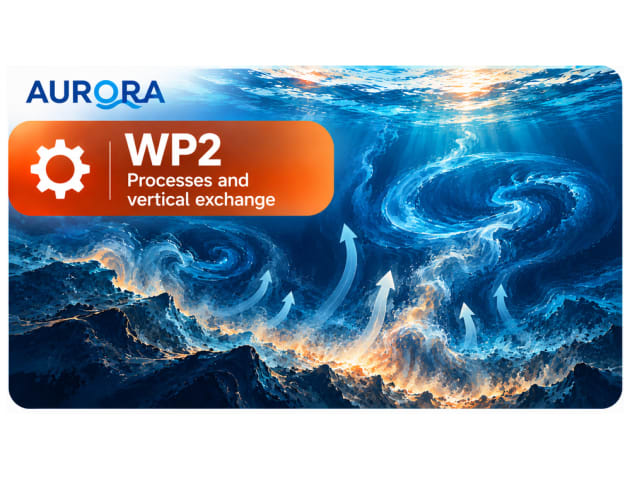
AURORA translates its scientific questions into three complementary Work Packages. WP1 builds the observational picture of deep upwelling in the Ionian Sea, combining existing and newly collected data to identify hotspots and characterize their three-dimensional structure and variability. WP2 focuses on the processes that generate vertical exchange, investigating the role of turbulence, internal waves and tides, boundary mixing, topographic interactions, and mesoscale dynamics. WP3 brings these observations and process-based insights into numerical models, testing their ability to reproduce deep upwelling and assessing how model resolution, configuration, and parameterizations affect its representation
Project structure
Observations, process studies, and modelling work together to reveal and predict deep upwelling

AURORA is designed as an iterative observing–understanding–modelling framework rather than as a sequence of independent activities. Observations collected in WP1 reveal where deep upwelling occurs and guide the investigation of the responsible mechanisms in WP2. The resulting process understanding is incorporated into WP3 to test and improve numerical models. In turn, model results help interpret the observations, connect processes across scales, and identify the conditions under which deep upwelling develops. This continuous exchange between observations, process studies, and modelling allows AURORA to move from detecting deep upwelling to understanding its dynamics and ultimately predicting its occurrence
Work packages / Modules
Milena Menna - Head of unit
Tools: historical data, deep mooring equipped with high frequency temperature sensors, ADCP,s CTDs and currentmeter, long endurance glider, deep Argo, two scientific cruises, models
Key outputs:
- Maps of deep upwelling hotspost
- 3D structure and temporal variability of upwelling
- Hydrographic and circulation datasets from glider, Deep-Argo, mooring and research cruises
Nadia Lo Bue - Head of unit
Tools: shipbord VMP casts, high-frequency temperature sensors, Argo floats
Key outputs:
- Quantification of turbulent mixing and diapycnal diffusivity in key areas
- Role of internal waves,tides, boundary/topographic processes and eddies in driving upwelling
- Process-based understanding in vertical exchanges and water masses transformation
Stefano Querin - Head of unit
Tools: model simulations
Key outputs:
- Assessment of models’ ability to reproduce observed upwelling
- Optimized model configurations and parametrizations
- High-resolution simulations of vertical transport and water-mass transformation
- Implications for the Mediterranean thermohaline circulation